17 Mar 2014

Hippie Deluxe

Nineteen sixty-five launched a decade of revolution, as social, political, artistic, and cultural conflict transformed life in The States, Britain and Europe. The period witnessed the expansion of protests against the Vietnam War and in support of civil rights, as well as the birth of the women's and enviromental movements. Youth rebelled against the stablishment and rejected the values and aspirations of previous generations by experimenting with drugs, plunging into the sexual revolution, and rejecting material definitions od success. The young people who would soon become known as hippies.

Jimi Hendrix (left), Grace Slick & Janis Joplin (centre), and Jim Morrison placed the Hippie look on stage.

The Beatles: by 1967 their starched collar were gone. Instead, the band wore their hair shaggy and posed in an eclectic assortment of colourful prints, velvety, and furs.

  
The Bestles to ok the world by storm in matching outfits in 1963 ( left pic). By 1967, Paul, Ringo, George and John had traded in their staid suits for a more flamboyant style, seen at a press event for the Sgt. Pepper album release (right pic).


For hippies, vintage clothing provided an artful appearance at little cost, and was in harmony with their rejection of materialism and their embrace of the no commercial.

Hippies plundered Salvation Army and vintage store for their colourful "dress-up box" appearance, combining different eras, from the Renaissance, like granny dress, dandy suit, and gypsy skirts that evoked lust fantasies of bygone eras.

Thea Porter Dress with colourful butterfly print from about 1970. The saturated hues and loopy drawing style clearly reveal the influence of psychedelic grapic art. 

Young Londoners in General were rejecting mass produced clothing and pushing the boundaries of mod fashion, experimenting with more outrageous psychedelic style.

Vibrating colours of psychedelic commercial art: The american band Jefferson Airplane, The album Yellow Supmarine, and The Fool. 

The word 'ethnic' came to be used as a catchall for the accumulation of textiles, accessories, and clothing from across the globe that were worn alongside vintage fashion.

The values of indigenous people was an important aspect of the counterculture. They perceived many 'primitives' cultures as more natural than their own, lacking the materialism of corporate-controlled Western Sociaty.
The ethnic look was particularly popular on the West Coast, in Los Angeles and San Francisco, and has since become identified with iconic rock stars such as Janis Joplin, Jimi Hendrix, Grace Slick, and the Doors.

Giorgio Sant'Angelo (left) was likely inspired by Sandro Botticelli's early Renaissance masterpiece Allegory of Spring( middle picture), in creating fantasy dressin sheer printed sink. In the early 1970's, british designer Ossie Clark (right) accentuated a Celia Birtwell floral print with a plunging neckline, gathered skirts, full sleeves, and delicate touch of stitched floral.
Youth was sovereign. Camp dethroned good taste. The rich stole their fads from hippies who rejected materialism. Tradicional Seventh Avenue designers including Bill Blass, Norman Norell, Oscar De la Renta, and Geoffrey Beene incorporated elements of street style in their high-end ready-to-wear designs, developing the "rich hippie" look for their well-heeled customers.

Model Veruschka wearing a Valentino poncho dress. Brazilian Magazine: Claudia 1969.

Celebs adopted hippie garments in their lifestyle: Liz Taylor (left), Barbra Streisand (centre) wore a adapted Indian Sari to the American Diabetes Association Benefit in April 1970, and princess Grace Kelly.

Fashion publication: Tweegy And Veruschka

Paris haute couture, which was equally receptive to influences coming from the youth on the street, turned out luxurious garments. A long way from its counterculture roots, hippie chic was born.

A rich patchwork of coloured silks, satins, and velvet por this Yves Saint Laurent dress. L'Officiel Sep.1969. 

Giorgio di Sant'Angelo crafted a dress for his fall-winter 1970 collection from lush velvet and trimmed it with woven ribbons that evoked the trade items incorporated as decoratives elements in the dress of Native American tribes in the 19th century.


Model Jean Shrimpton wearing one of the dresses from Goirgio di Sant'angelo first collection, which featured multiple skirts over embroidered lace pant and a romantic blouse. 

Gloria Vanderbilt was one of the many New York socialites to embrace the patchwork craze, turning old quilts into garments and furnishing fabrics (vogue, February 1970)


Caftan. Vogue Italia. March 1969


The spirit of hippie chic lives on.

25 Feb 2014

Fashion gets Physical

In the 1970's, active wear began to set new style records and it hasn't slowed down yet.

 1970's

in 1977, American Vogue published the first picture with famous and glamorous  actress Farrah Fawcett appeared skateboarding in her favourite sneakers, the Nike "SeƱorita Cortez" running shoes- and they looked as chic as anything the magazine's readers had ever seen.


1980's 

workout in the music and of course in fashion

In 1981another blonde with dazzling teeh, Olivia Newton John and her song "Physical", the album reached top 10 in Japan, New Zealand, Canada, The States, and her native Australia. "I wanna get Physical", she sang- and Fashion did too.
In 1982 Jane Fonda released her first exercise video titled "Jane Fonda's Workout", became the highest selling home video of the next few years. Aerobics and Jogging were more than just that ecade's popular workouts, they were sexy.

the 80's stars: Brooke Shields / Olivia Newton John / Jane Fonda

1990's

 In 1984, Ralph Lauren opened the Polo Sport Emporium in the glossiest shopping districts, "New York's  Madison Avenue. The Store sells everything from ski boots and hiking apparel to fragances with the Polo imprimatur, raising active wear to high fashion.


In 1991, Chanel, whose head designer, Karl Lagerfeld, has toyed with scuba Tailleurs and Lycra legging. The athletic style has met Ready-to-wear collections.

left picture: Chanel 1991
Right Picture: Michael Kors 2013

2014's

Last Vogue Paris essue published a photoshoot about style & sport.


Sport influence in the last collection. Spring/summer 2014 


Tommy Hilfiger / Emilio Pucci / Prada

Marni / Marc By M. Jacobs / Lacoste


1 Feb 2014

The T-shirt in the history.


When you ask yourself what you'd rather be wearing, the first answer is a T-shirt. Simple, comfortable and always stylish. Nowadays, this garment is accepted as appropriate dress almost anytime, everywhere and we could find it for just £2 in Primark or £500 in a Versace Store.

The T-shirt evolved from undergarments used in the 19th century, through cutting the one-piece "union Suit" underwear into separate top and garment.

1913 The First T-shirt Models

White cotton, crewneck T-shirts became regulation underwear for the U.S Navy. Two decades later, at the University of Southern California, football players don similar shirts to prevent chafing from heavy shoulder pads. the tees became so fashionable that students start pilfering them for casual wear.


Printed T-shirt

The earliest printed shirt was perhaps the Air Corps Gunnery School T-shirt featured in 1942 cover of LIFE magazine and Mickey Mouse would follow suit a few years by Sam Kantor in Miami, Fl.


First Printed T-shirts / the Union-suit underwear /first Mickey printed in a T-shirt.


Hollywood in the 50's

By the mid-1950s the T-shirt had become the symbol of the new teenager and of the rock 'n' roll rebellion. Hollywood Rebel Stars, like Marlon Brandon and James Dean exuded animal magnetism when we wore a thin, white T-shirt. the T-shirt is only a thin veil, meant to cover not only his rippling physique, but also their character's bestial urges.

James Dean & Marlon Brandon in the 1950's


Concert T-shirts in 1960's 1970's and the present

Different Bands (Rock 'n' Roll, Punk, Pop, etc) adoped the T-shirt in Concerts. Another succesful bussines were (and still in use) the Concert Tours printed in T-shirts as Merchandising.   


The Ramones Concert, 1977.


I Love New York

1970's, New York gained a reputation as a tourists' nightmare-dirty, decadent and crime-ridden. To revitalize the city imagen, the Conmerce Department hired designer Milton Glaser to fashion an eye-catching logo for the city. over lunch one day, Glaser sketched "I ♥ NY" on a napkin. The logo spearheads a resurgence in New York tourism and became the most imitated T-shirtdesign in history.


American Series

in the 80's, Don Johnson sport a T-shirt as part of an ever-changin, candy-coloured wardrobe on the television series "Miami Vice". The look, replete with rolled-up jacket sleeves and slip-on sockless loafers, take off like wildfire. To this day, the combo T-shirt-and-jacket persists.


 The present

Nowadays, T-shirts are so fashionables as the first time. 

S/S 2014 ; Gucci / Calvin Klein / Versace / diesel


18 Jan 2014

Sunny Style


Sun-glasses has long been associated with celebrities and film actors primarily from the desire to mask their identity. Since the 1940's sun glasses has been popular as a fashion accessory, specially on the beach.

You can see below pictures from films (some of them are my favourites !!!) where sun-glasses are the main accessory for each character.

What are your favourite one ?


Tom Cruise in Top Gun. 1986.

Robert De Niro in Taxi Driver. 1976


Bradley Cooper in The Hangover, 2009

Madonna in Desperately Seeking Susan. 1985
Audry Hepburn in Breakfast At Tiffany's. 1961

Sue Lyon in Lolita. 1962


Arnold Schwarzenegger in Terminator. 1984

Marcello Mastroianni in La Dolce Vita. 1960
Catherine Deneuve in Belle de Jour. 1967. 

Zach Galifianakis in The Hangover. 2009


Audrey Hepburn in Charade. 1963


Grace Kelly in To Catch a Thief. 1955


Audry Hepburn in How to steal a Million. 1966


Michelle Pfeiffer in Scarface.1983


Steve McQueen in The Thomas Crown Affair. 1968

Cary Grant in North by Northwest. 1959


12 Jan 2014

A 40 years old Dress - The Wrap Dress


"All I had was an instinct that women wanted a fashion option besides hippie clothes, bell bottons and stiff pant suits that hid their femininity", in the early 1970's Diane Von Furstenberg decided to combine the two pieces into one garment: The Wrap Dress.


Diane Von Furstenberg, the designer.

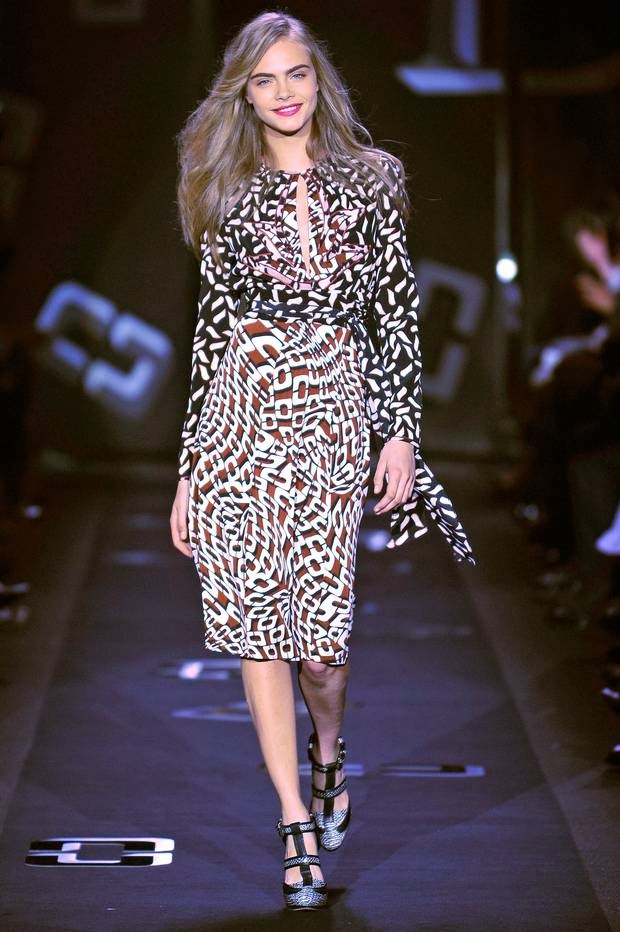
The go-anywhere wrap dress rapidly became a best-seller among working women and celebrities. it featured a V-neck that was formed by tying the wide, wrap sash around the waist and the bodice was cut to fit closely to the body, with long, narrow, set-in sleeves.


The dress coult be worn in the evening with high heels and and jewellery, or under a blazer for the office. with no zip fastening, hooks and eyes or bottoms, the dress became symbolic of women's sexual liberation.


Newsweek cover 1976.


The dress was easy to to put on and equally easy to take off. The Diane Von Furstenberg Studio produced easy-to-wear cotton and rayon blend knit dresses in the designer's signature wood grain and small-scale geometric prints from 1970 to 1977, introdicing snake and leopard prints in 1974, long dresses and halter neck dresses were later added to the collection.